
Tree of Knowledge- TMI! (Let’s Just Eat What’s Right)

Goat-eating-appleHave you eaten the apple from the “Tree of Knowledge”?!

In other words: Have you learned of all the scientific studies on various diets, becoming capable now of accurately choosing the wisest diet plan for yourself?

Perhaps you have read all the latest info on how you should eat this kind of organic meat/poultry/fish (plus veggies only), or that you should just eat raw foods, or that you should substitute nuts for grains (to get rid of that “wheat belly”), or that you shouldn’t eat fat because the gut flora of mice fed low-fat diets with a side of healthy gut bacteria were able to lose weight, while those eating a fatty diet, even after also getting the healthy bacteria, were not able to?

In other, other words, have you obsessed about what might be the best diet for you?

Since man seems to be at such odds, with one study or dietary lifestyle contradicting another, maybe it IS time to just go to the Bible. I’m convinced that God has designed things perfectly. There is wisdom in Biblical eating. If His word talks about eating grains, it’s hard for me to invest in the whole “Caveman didn’t eat this, and we aren’t supposed to either” theory.

I was obsessing about the phytates in whole grains, nuts, and seeds. For awhile there. But then I read about how, even though phytates can cause inflammation, they do serve some purpose. In moderate amounts, they can reduce excess tumor growth (a natural cancer-fighter). Inflammatory diseases seem prevalent right now, but I suspect the pendulum could swing the opposite way if certain dietary trends become extreme. Some folks, who could actually benefit from some extra phytate/inflammatory foods, might end up with… I don’t know- extra tumor growth or something?!

In any case, I do agree that the modern diet’s messed up. Think of how God originally designed things. HE did not design the machines that so readily create products so cheaply (things like refined flour, sugar, bread, oils, junk food, etc.). Modern society finds junk foods too easily accessible and too cheap, and we’re spoiled. If we had to grind our own flour, kill our own chickens, make our own olive oil, get our own honey from the honey comb… we’d probably be in perfect health!

Ha ha… my thought for the day 😀

*Image used by permission

I Am Cave Woman?! (Really? Hear Me Roar?)

Gorilla DisputeMaybe I’m getting too old for this blogging stuff. Even my silly title won’t be understood by new generations. After all, it’s a reference to a goofy song by Helen Reddy, from the seventies: “I Am Woman“. (“Hear me roar” is part of the lyrics.)

And I don’t mean to raise a stink, but I take the Bible literally. I don’t think my ancestors were monkeys. I actually do believe my ancestors were Adam and Eve, and that they ate the plentiful fruits, nuts and berries that grew wild in that original Garden of Eden.

Given that, I could imagine why some folks would be keen to recreate that diet in their own lives. Raw foodies might even say, “Hey, this is how we were meant to eat, before sin entered in.”

But, sin did enter in. And since God is timeless, He already knew that would happen. So, I don’t think He created the Adam and Eve Model without taking into account that sin was going to happen. Adam and Eve would be banished from that Garden, their diet would change, and God knew it.

I think God had already addressed what physical necessities there would be when Man’s lifestyle changed. Since the Bible talks so much about cultivated crops, grains, olive oil, meat and such, I believe God created us to be able to digest all that stuff.

It would be a bit short-sighted if God had built us one way, and then said, “Oops- that’s not going to work. Oh well. Sigh.”

Not that I’m trying to lay down my own idea of a perfect diet. Who’s to say what’s best for someone else? I love Paul’s words (in the God’s Word version) of Corinthians 8:13: “Therefore, if eating food [offered to false gods] causes other believers to lose their faith, I will never eat that kind of food so that I won’t make other believers lose their faith.”

Bottom line: I don’t want to be more focused on food than on God. There’s a lot of info on healthy eating, but much of it is contradictory. That’s messed up. How much simpler to just recognize, “Everything God created is good. Nothing should be rejected if it is received with prayers of thanks.” (Timothy 4:4)

Ideally, I’m eating to nourish my body with what God has provided. Sometimes, that might be a shared meal that isn’t what I’d normally eat. But that’s OK!

Life is much simpler when we turn to our instruction manual: God’s word! He tells us, “He who seeks to save his life shall lose it.” Maybe a lot of folks try to save their lives through diet. I know I have! I tried every approach. And while it’s good to eat fresh, whole foods, one shouldn’t obsess about it, right?

I can imagine there are some legit diets for improving health issues. For the person used to living on junk food, almost any of these diets will be an improvement.

Enough thoughts for today. Anyone else want to weigh in?

*Image used by permission, by Andreas Krappweis

Special Deals on Health Food & Fingers Do the Ordering!

Sprout Master- Best Sprouter!You can tell a lot by what a person buys. I’m sharing my list from this morning, for those who might like a head’s up on some good values. (I love shopping when I’m getting value.)

I wasn’t always an online shopper, but it’s making more and more sense. In the old days, if we needed some special item for the deli, Tom and I would have to go on a day when we weren’t working. But usually, the only days we’re not working are vacation days, which are pretty rare.

When we needed a new industrial-strength Cuisinart, Amazon had the best price. And we didn’t have to run around looking for it!

When I bought our latest stainless steel pressure cooker on Amazon, I discovered it was even better than the one I’d just purchased at the local hardware store. More points for Amazon.

This morning, I stocked up on more good stuff, from the grocery category. I didn’t even have to pay shipping, since I got big enough quantities to qualify for free shipping. (If you have “Amazon Prime”, you’d probably get free shipping regardless of quantity ordered, which is pretty cool.) You might want to check out these items!

30 lb. organic hard red wheat berries
Now that I have a Vitamix, I grind my own whole wheat flour for sour-dough bread. I ordered this 30 lb. bag of whole wheat berries, since the price proved cheaper than I could get locally. Yes, an investment, but… a good one!


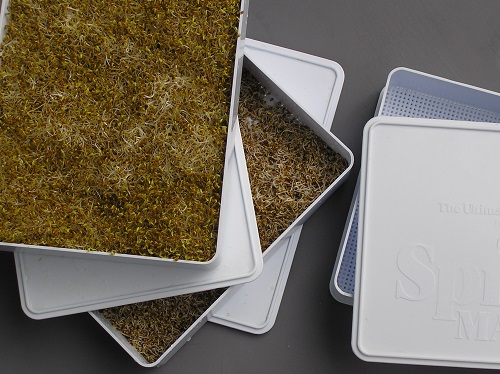
I also got a new set of sprouters, since my friend needed one tray. It’s cheaper to get three, and I’ll keep two for the deli. BTW, this is THE best way to sprout sprouts! I’ve had a couple sets of these for years, which I use daily for growing deli sprouts. They’re so popular, I need extra trays to keep up with the demand!


I got this organic tart cherry concentrate too, which I use it to flavor my kefir water. It’s super great for your joints and such. (My dad just takes it straight- a spoonful a day.)


AND, I snagged some organic chia seeds. Yes, Trader Joe’s is selling the seeds cheaper, but they’re not organic. And the health food store sells organic, but can’t beat this price, for a 2-lb. package.


Not to mention, I stocked up on coconut oil. This is still the best value you can find for this stuff! Especially when you order enough to get free shipping 🙂


Oh, and I got more coconut palm sugar. It’s perfect for the healthy breakfast bars I’ve been making us for breakfast lately. Lots of minerals, and lower in the glycemic index (yay, no sugar drop off afterward!).

Easy, Healthier “Chocolate Graham Cake” Recipe, Paleo-ish!

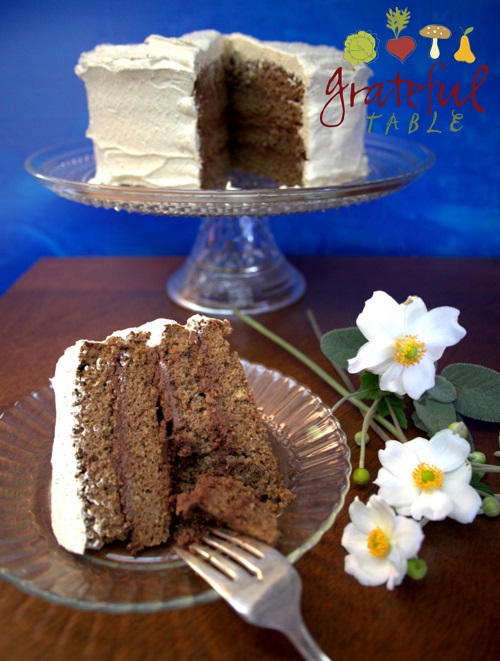
This is a fairly quick, easy cake recipe, and provides a somewhat healthier version of the standard chocolate cake. Fresh-ground whole wheat flour is ideal; by using whole grain flour, coconut palm sugar to sweeten, and a hearty portion of eggs, it will be less likely to produce a carb overload!

I call it a Chocolate Graham Cake, since home-ground whole wheat flour can be a touch coarser than the usual store-bought whole wheat. It doesn’t actually have graham crackers in it, and it’s not even “graham flour” in the strict sense of the term. But it sounded good!

Natural fruit juice concentrate is brushed between layers to add moistness, and an easy “chocolate mousse” is spread between the layers, with a faux buttercream to frost the cake, made with butter, coconut palm sugar, some confectioner’s sugar, and almond extract. A delicious cake, serves 10-12.

Easy, Healthier Chocolate Cake

INGREDIENTS

  • 1/2 c. coconut oil
  • 1/2 c. yogurt
  • 6 eggs, room temperature
  • 1/2 c. + 1/2 c. coconut palm sugar
  • 1/4 c. cocoa powder
  • 1 1/2 tsp. vanilla
  • 1 1/2 c. whole wheat flour (preferably fresh-ground)
  • 1 tsp. salt
  • 1 1/2 tsp. baking powder
  • 1/2 c. + 1 c. butter, room temperature
  • 1 c. chocolate chips
  • 1 c. confectioner’s sugar
  • 1 1/2 tsp. almond extract
  • 1/2 c. frozen fruit juice concentrate (black cherry, raspberry, or other favorite)

CAKE PREPARATION

1. Oil two 8-inch cake pans, then dust with flour.

2. Preheat oven to 350 degrees.

3. In glass measuring cup, measure coconut oil; let melt in oven a few minutes. Use: > 1/2 c. coconut oil

4. Add yogurt to melted oil. Use: > 1/2 c. yogurt

5. Add to a mixing bowl and whip several minutes, until light and fluffy: > 6 eggs, room temperature > 1/2 c. coconut palm sugar

6. To the cup of yogurt and melted oil, add: > 1/4 c. cocoa powder > 1 1/2 tsp. vanilla

7. Measure onto paper, mixing some to blend: > 1 1/2 c. whole wheat flour > 1 tsp. salt > 1 1/2 tsp. baking powder

8. Fold dry ingredients into whipped egg/sugar mixture, then fold in the oil/yogurt/cocoa powder/vanilla mixture. Turn out into the prepared cake pans; bake for 25 minutes at 350 degrees, until toothpick stuck into center comes out clean.

9. Remove cake from pans and let cool while preparing the filling and frosting.


FILLING AND FROSTING PREPARATION

1. Melt the chocolate chips and butter, stirring until smooth. (The warm oven can do this, or the microwave works.). Use: > 1/2 c. butter > 1 c. chocolate chips

2. After stirring the chocolate/butter mix, let cool some. (Refrigerate, or let sit out for hours.)

3. For frosting, whip until light and fluffy: > 1 c. butter > 1/2 c. coconut palm sugar > 1 c. confectioner’s sugar > 1 1/2 tsp. almond extract

4. Set frosting aside and whip the “chocolate mousse”, using the cooled chocolate chip/butter mixture. Whip until lighter in color, several minutes. (If chocolate mixture’s too warm, refrigerate it a bit first.)

5. When cake has cooled, split the two layers. Sprinkle each cut layer with: > 1/2 c. Frozen juice concentrate, thawed (flavor of choice)

6. Spread the chocolate mousse between each layer.

7. Assemble the cake, then spread with the frosting. Serve at room temperature.

Oatmeal Breakfast Bars: Quick Meal on the Run, but Healthy!

I had “fun” working with amaranth (a high-protein seed that can be too crunchy or too gelatinous, if not prepared right). For that recipe, see Hi-Protein Amaranth Oat Breakfast Bars.

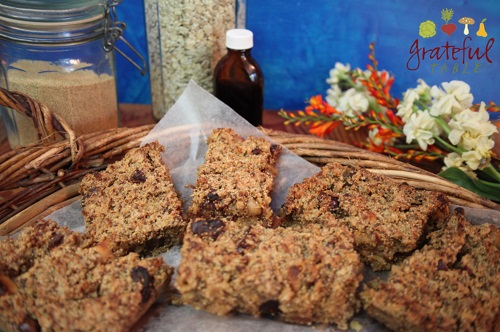
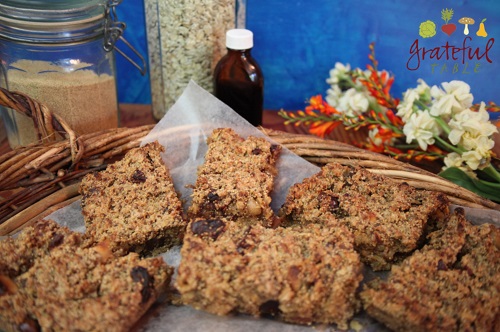
Oat and Amaranth Breakfast BarThis is the easy version of that recipe. It can be easily doubled; this small batch makes about 4-6 servings. Store extra in refrigerator, for up to a week.

INGREDIENTS

  • 1/2 c. buckwheat groats or quinoa
  • 2 c. old-fashioned rolled oats (*or 1 c. steel-cut oats; see note at bottom of page)
  • 2 TBS. chia seeds
  • 1/4 c. water
  • 1/2 c. raisins or dates
  • 1/3 c. coconut palm sugar
  • 1/4 c. coconut oil
  • 1/4 c. macadamias (or other favorite nut)
  • 1 tsp. vanilla
  • 1/2 tsp. salt
  • optional: 1 tsp. cinnamon or other spices

PREPARATION

1. Soak grains in a bowl of water for a day or so. Use: > 1/2 c. buckwheat or quinoa > 2 c. rolled oats

2. To prepare the “batter” for these bars, add to a mixing bowl, letting the chia seeds absorb the liquid, stirring some if necessary: > 2 TBS. chia seeds > 1/4 c. water

3. Rinse the soaked grains, letting them drain while adding the following to the chia seeds in the bowl: > 1/3 c. coconut palm sugar > 1/4 c. coconut oil, melted > 1/4 c. macadamias (or other favorite nut) > 1 tsp. vanilla > 1/2 tsp. salt > optional: other spices

4. Stir until the mixture is blended, then stir in the drained grains.

5. Add mixture to an oiled 9″x9″ square pan.

6. Bake at 350 degrees for 25 minutes.

7. If a slightly browned top is desired, broil the pan of bars for a few minutes, until golden.

8. Turn oven off, let finish baking with oven off for 25 more minutes. Serve warm or cold.

* To replace rolled oats with steel-cut oats, use half as much (1 c.), letting soak at least a day. Drain, rinse, and even let sit another day if possible. Use as is, or process in a food processor to achieve a softer texture.


Carrot Soup w/Dill: Nutritious, Delicious!

You can still order my ebook, SOUP’S ON! But if you want a “peak” at recipes, I’ve posted the following…

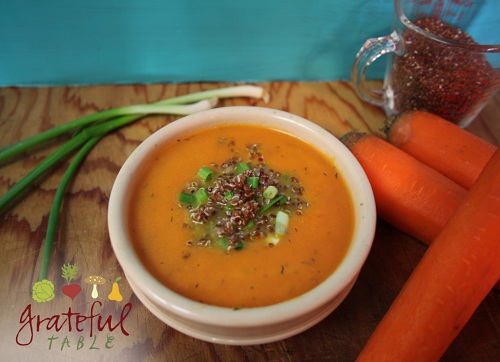
Caraway seeds are often added to rye bread, but are a fun flavor to season this dish with too. Potatoes tone down the sweet carrots; colorful red quinoa makes a good garnish. Serves 6-8.

Carrot Soup garnished w/ Dill Weed, Quinoa

INGREDIENTS

2 lb. carrots, peeled and chopped into discs

2 lb. potatoes, peeled, cubed

1/4 c. virgin olive oil

1/2 tsp. caraway seed

1 1/2 tsp. salt

1/2 tsp. dill weed

Black pepper

Optional: Cooked quinoa and chopped green onions for garnish

PREPARATION

1. Give carrots a head start cooking, as they take a bit longer than potatoes. Simmer about 20 minutes: > 2 lb. carrots, peeled and chopped into discs > boiling water to cover

2. Set 1 c. or so of the cooked carrots aside, if desired. These can be added back into the pureed soup; the slices of carrot will add texture to the otherwise creamy soup.

3. To the remaining cooked carrots in the pot, add and cook until potatoes are tender: > 2 lb. potatoes, peeled, cubed

4. Process the potato/carrot mixture until smooth, using immersion blender or food processor. If using food processor, process lightly, so the potato starch doesn’t get overdeveloped (making the consistency gummy.) To the pureed mixture, blend in: > 1/4 c. virgin olive oil

5. To5ast: > 1/2 tsp. caraway seed

6. Put all ingredients into pot: > Pureed potato/carrot/oil mix > toasted caraway seed > 1 1/2 tsp. salt > 1/2 tsp. dill weed > black pepper > reserved cooked, sliced carrots (optional: “caramelize” the sliced carrots by grilling first, which develops their sweetness)

7. Reheat soup; garnish with: > Cooked red quinoa (optional) > chopped green onions

How To Cook Amaranth, Beans, Buckwheat, Cocoa Nibs

This is part of a series on Core Ingredients (how to cook them). Find more in this post: How to Cook (and Use) Millet

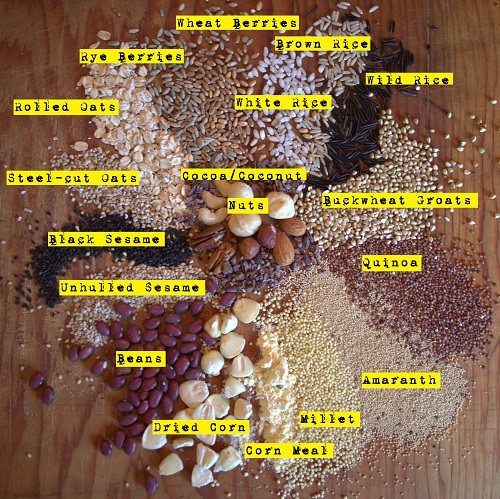
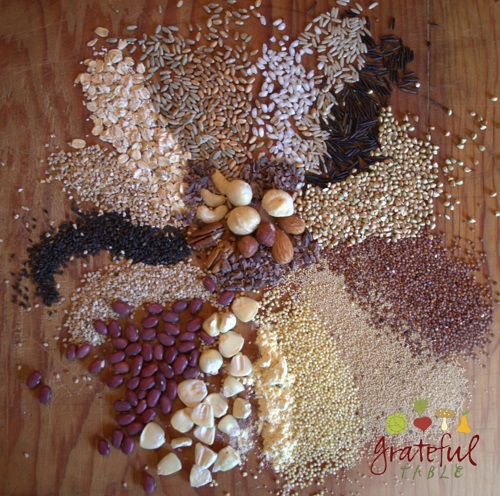
Grateful-Table-About-Grains-Beans-Seeds-NutsI could imagine that you really do want to know how to cook every grain. That you want to know all these details. But I’m coming to realize… most folks aren’t as “into” this as I am! My son stopped by the office, seeing my photo of grains on the computer. “Whatcha doing?” I told him I was adding text to the photograph, so people would know what the various grains looked like. What does he say? “Mom, you’re a nerd.” Guess that settles that!

But hey, my buddies kept asking, “So, what’s amaranth again?” (I’ve been adding it to a breakfast bar recipe I’m developing, so they keep seeing it pop up…) If they’re wondering, I figured others might too. So I decided to go through the grain list, in alphabetical order below, and tell you what I’ve come to know about these various grains, nuts, and seeds. (There’s more info on these foods in my post on “High Phytate Foods“.)

Here’s the list:

Amaranth: My first purchase of amaranth sat in the cupboard for half a year; after I’d bought it, I did some research. One study showed that, the more amaranth used in a blind taste test of baked goods, the less the test subjects liked it. In other words, positive response was in direct relation to how little amaranth was in any given sample. This did not inspire me!

But I knew it was gluten-free and high in digestible, usable protein. And that it has lots of calcium, magnesium, and iron. And that it’s gluten-free. Amaranth means “everlasting” in Greek, and the Aztecs warriors were sustained by it. So it must have something going for it. So I researched how to actually use the stuff.

It looks like many frazzled cooks have consulted forums on the topic of how to cook amaranth. Made with too much water, it turns into a gelatinous mess; if it’s undercooked, it’s tough.

My solution is to soak the seeds/grains for a full day, before doing anything else. This will make them more digestible, and they should cook better too. Time permitting, I’ll even strain and rinse the amaranth and let it go another day (upon which they start to almost sprout). At this point, I drain them again and do one of two (or three) things:

1.) To 1 c. of soaked grain, add about 2 1/2 c. boiling water; cover, simmer 25 minutes or so, and serve in a pilaf-type recipe. It’s probably best to mix the cooked amaranth with another grain (rice or such), since that will mask the slightly gelatinous nature of the amaranth beast.

2.) Or, after soaking, add to a very hot iron skillet, a few tablespoons of amaranth at a time, stirring constantly. They will start popping; push the done grains to the edge and add more amaranth to the center of the pan, repeating until all of it is popped. Add this to baked goods, or continue on to actually cooking it in some water.

3.) Roast the soaked amaranth. This is easier than popping them in a pan. It lends a slightly nutty flavor; it can be cooked in double the amount of water, after the amaranth has been soaked and rinsed. Add to breakfast bars or other baked goods, or pilaf recipes. (Recipe for breakfast bars here.)

Beans: Easy- just soak overnight, before cooking the next day. Add a tablespoon of vinegar, if desired. Soaking will make the beans more digestible, AND, they cook faster!

Buckwheat Groats: This grain is almost as soft as oat flakes, which means that, even without a flour grinder, one can make buckwheat flour. A small, electric coffee grinder (or small food processor) will do the trick. Perfect for fresh-ground, gluten-free pancakes!

Buckwheat is also a nice grain to add to breakfast recipes (see this breakfast bar recipe). Or, toast the groats first, to use (like rice) in meals. Toasting brings out flavor, and improves texture. Some places sell buckwheat toasted, or toast your own by adding to a medium hot pan, stirring until all grains look toasty.

To cook as for rice, add 1 1/2 c. boiling water to 1 c. toasted buckwheat in a small pot. Bring back to a boil, then turn on low for 10-20 minutes, until water’s absorbed and groats seem tender.

Cacao Nibs/Chocolate: I’ve enjoyed “raw cacao nibs” in my smoothies, and in coconut bark. But I’ve started baking the nibs a bit, as I’ve heard that cuts down on the phytates, and brings out the flavor. Best of both worlds!

More Grains: What?! I’m only halfway through the “C” grains/nuts/seeds?! I will have to cover the rest of these at a later date… In an upcoming post, I’ll go through these:

  • Corn, Dried
  • Corn Meal
  • Millet
  • Nuts
  • Oats, Rolled
  • Oats, Steel-cut
  • Quinoa
  • Rice, Brown
  • Rice, White
  • Rice, Wild
  • Rye Berries
  • Sesame Seeds
  • Wheat Berries


Breakfast Bars- High Protein, Highly Delicious & Convenient!

Warning: Go straight to this recipe for EASY Oatmeal Breakfast Bars, if you’re not feeling too ambitious!

But before I simplified the recipe, I came up with the one below. It was a good vehicle for the amaranth I had purchased, after hearing how high in complete protein it was. (I didn’t know at the time of purchase, that cooking a real palatable amaranth dish could be challenging… Sigh!)
Oat and Amaranth Breakfast BarMy husband had only been looking out for me, hoping to save me some time in preparing his breakfast. (Yes, we’re a pretty old-school household- I do the cooking, he fixes the car. Etc. It works!)

I admit, I was starting to feel like Leave It to Beaver’s mom. So I decided to make a big batch of my own version of Breakfast Bars; then we would have at least a few days a week where breakfast could be extra fast and easy.

Working with amaranth, an ancient seed/grain, was not especially simple though. After my first attempt, one friend thought it had a weird, green aftertaste. It needed work. So, for the following recipe, I soaked the amaranth for a day, then roasted it, then cooked it, before even adding it to a recipe. Doing a taste test, we decided it was still quite good if I skipped the roasting process, which saved some time.

But grains become more digestible when soaked, and soaking the amaranth helps it to cook through, too, while still retaining a nice texture. It doesn’t take any “work” really, just some planning ahead. Ideally, it gets cooked enough to not seem too hard, but not cooked so much that it’s just a gooey blob.  A plus about amaranth: Bonus protein (usable, complete protein). 

If you prefer steel-cut oats, that variation is listed below the recipe. This recipe can be easily doubled; this makes about 4-6 servings (which last up to a week, refrigerated, if you don’t eat them first!).

INGREDIENTS

  • 1/2 c. amaranth
  • 1 c. boiling water
  • 2 c. old-fashioned rolled oats (*or 1 c. steel-cut oats; see note at bottom of page)
  • 2 TBS. chia seeds
  • 1/4 c. water
  • 1/2 c. raisins or dates, diced (about 10 dates)
  • 1/3 c. coconut palm sugar
  • 1/4 c. coconut oil
  • 1/4 c. macadamias (or other favorite nut)
  • 1 tsp. vanilla
  • 1/2 tsp. salt
  • optional: 1 tsp. cinnamon or other spices

PREPARATION

1.  Soak amaranth for one day. The following day, rinse, drain, and let sit one more day if there’s time; otherwise, one day’s soaking will do. Use: > 1/2 c. amaranth

2. Also soak the oatmeal, to get rid of extra phytates that can interfere with digestion. Use: > 2 c. old-fashioned rolled oats

3. After a day (or two) of soaking, rinsing, and draining the amaranth, roast the grain. Spread the amaranth on a cookie sheet and roast in a 375 degree oven for 10 minutes. **See note at bottom of page if you’d prefer to pop your amaranth, rather than roast it. It will be crunchier, if you prefer that.

4. Cook amaranth in small pot for 10 minutes or so. To the 1/2 c. soaked, roasted amaranth, add: > 1 c. boiling water

5. While amaranth simmers, prepare other ingredients. Add chia seeds and water to a mixing bowl, letting the chia seeds absorb the liquid, stirring some if necessary. Use: > 2 TBS. chia seeds > 1/4 c. water

6. Rinse soaked oats, then let drain while adding the following to the chia seeds in the bowl: > 1/3 c. coconut palm sugar > 1/4 c. coconut oil, melted > 1/4 c. macadamias (or other favorite nut) > 1 tsp. vanilla > 1/2 tsp. salt > optional: cinnamon or other spices

7. Stir until the mixture is blended, then stir in: > The drained oats > The cooked amaranth (or the popped amaranth, if preferred).

8. Add mixture to an oiled 9″x9″ square pan.

9. Bake at 375 degrees for 25 minutes.

10. If a slightly browned top is desired, broil the pan of bars for a few minutes, until golden.

11. Turn oven off, let finish baking with oven off for 25 more minutes. Serve warm or cold.

* To replace rolled oats with steel-cut oats, use half as much (1 c.). Process the steel-cut oats some, so they’ll cook better. Soak for a day, drain, and rinse.

**To pop amaranth, get an iron pan quite hot, adding a few tablespoons of soaked, drained amaranth at a time, to the pan. Stir constantly, pushing the popped grains to the edge of the pan as more amaranth is added. Continue until all amaranth has been added. Not all of it will pop–that’s OK. Set aside when done. Add to the other ingredients when mixing them all together.

The Phytate-Sphere: Soak Grains, Eat “Sensibly”, Don’t Worry

Foods High In PhytatesBran is not  as trendy as it was ten or twenty years ago. I remember the days- we used to stop by our favorite bakery and consume mass quantities of sugary, sweet bran muffins (probably loaded with unhealthy oils too). I was having a bran fest- I even added raw bran flakes to my cereal. All in the name of “FIBER”!

Was it any wonder that I had some serious anemia? Bran is particularly rich in phytates, which can bind with the iron and other minerals in our system, which can lead to that anemia. Who knows what other health issues might have been connected to my “bran diet”?!

Bran is quite high in phytates; phytates can also be found (in lesser quantities) in grains, beans, nuts, and seeds.  So I’m not a bran fiend anymore. And I do try to soak my grains. Or I ferment them–I’ve really been into homemade, whole-grain sourdough bread lately. (Now that I have a Vitamix that grinds my whole wheat berries into  fresh whole wheat flour…)

Not that I’m not going on a Phytate Rant here. Phytates can be good. Consuming them in our foods probably isn’t going to upset the average person’s health. One caveat: but it might.

Just as in the bran days of yore, any one food trend might lead to unbalance, as the misinformed attempt to overcompensate, adding too much of a good thing to their diets. One of the latest trends is the “Gluten-free” craze (and the GAPS diet). One catch: folks might start chowing down on that gluten-free cake, made with almond meal instead of flour, on a fairly regular basis, telling themselves that this will help them to avoid gluten and regain health. The cost might be a phytate overload…

That was me. After bran went out of style, I forgot about it and prided myself instead on eating “healthy” breakfasts of raw, soaked grains topped with nuts, cacao nibs, and coconut. Another vegetarian meal or two might follow, featuring beans and/or grains. A snack or dessert might include a treat high in cacao nibs and nuts. Ironically, that particular diet of “wholesome” whole foods might have been slightly unbalanced. (Ya think?!)

Not to sound the alarm. There is a plus side to ingesting those phytates. Yes, they are enzyme inhibitors, but also: They can bind to excess minerals in our system. This is a valuable service, considering that excess iron generates free radicals in our bodies. So, while excess phytates might be a problem for an anemic person (like I’m prone to be), they would help someone else who was prone to an excess of iron.

Also, phytates act as antioxidants. They can even fight the proliferation of cancer cells, and improve cardiovascular health. One other feature: They might lower a food’s glycemic load, for the very reason that they slow digestion.

In conclusion: Moderation is our friend. We might consider reducing a potential overload of phytates by soaking some of our grains, beans, seeds and nuts (this will break down phytates, allowing for easier digestion). We might make bread (the yeast/fermentation process decreases phytates), and we might toast some grains, seeds (which also decreases them).

But, unless you’re going off the deep end (like I’ve often done), you can probably just adhere to this simple rule: Eat a sensible diet, be aware of the danger of raw nuts, grains, and seeds consumed in excess, and then… don’t worry about it!

I Drunk My Kefir (Did That Have Alcohol In It?!)


Grateful-Table-Alcohol-in-Probiotics-NOT
I was going to post on the pros and cons Kombucha vs. Kefir. But that post will  have to wait. For now, I don’t even know if this is a pro or con: You won’t get drunk from your Kefir. You can try to ferment it for twice as long, but before you open that bubbly drink, put on your face-mask and helmet.

Fortunately, my 30-year-old son suffered no damage when experimenting. But he’d tried to up the alcohol content by letting his kefir ferment a full four days. He’d put the brew into an old Grolsch bottle–the kind with a ceramic stopper, rubber ring, and metal straps to hold it on tight. Well, it got quite carbonated; when he went to open it, the entire metal casing shot right off the bottle, like a rocket, along with the ceramic stopper. Seriously, watch out when playing with kefir!

Alas, my son did not get drunk off the brew. But I’m sure his gut was happy.

Meanwhile, I brought some “kefir soda” to my women’s group. I was anticipating squeals of delight as they all began to imagine how they, too, could brew this stuff. (I even brought along some extra grains, in case anyone was so inspired.) Instead, one of my friends decided she could taste the alcohol, and that she was in fact feeling tipsy. She admitted that she’s very sensitive to alcohol, but… really?!

Of course, that encouraged the entire group to suspect that the real reason for my effervescent mood was just the alcohol talking. My pride was a tad wounded. I take this health stuff so seriously!

But I had to be a good sport. It was all in jest. I pretended I was drunk, but put the extra grains back in my bag. No one seemed too eager to take on a new kefir project.

Kelly the Kitchen Kop (see her post here) had the same concerns as me, what with an extended family suspecting she might be turning her kids into boozers. So she went to quite a bit of effort to determine just how much alcohol is in kefir. Her findings: Less than 1%, which concurs with other findings.

Cultures for Health goes into detail, but basically, alcoholic content of normally-brewed water kefir is lower than 1%. They say that all cultured and fermented foods contain a small amount of naturally occurring alcohol, but it is usually significantly less than 1%.

However! If you actually wanted more alcohol in your kefir, you could use 100% juice in the first ferment (along with the sugar), adding the grains right to the juice/sugar mix. (But only go for 24 hours, lest you have an experience like my son had…)

Oh, and if you love the idea of Kefir Beer, this page goes into detail.

I will have to do a home-brewery experiment at some point, if only out of curiosity. I’m considering that I could brew something very strong and alcoholic, and drink it before the next women’s group meeting. Just so we could compare the “really” drunk me with the regular one. But… I probably won’t go that far.