Coconut Oil for Mental Health: Why/How To Use, Where to Buy

It’s not just an exclusive club that gets hit with Alzheimer’s and Dementia. Anyone can fall prey to these horrible conditions. But truthfully, I hadn’t given it much thought until earlier this year, when my 73-year-old mother became suicidal, paranoid, and delusional.
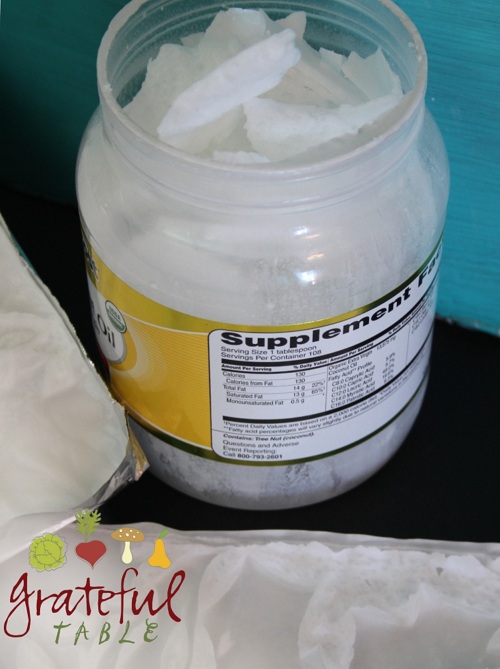
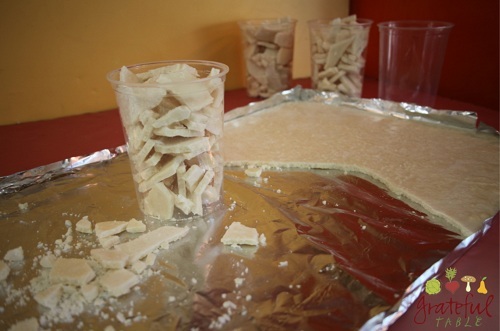
Grateful-Table-Coconut-Oil-MCTs

Let the oil melt in a low-temp oven (or use double boiler); pour onto aluminum foil, chill, then break into easy-to-use pieces!

Mom had always been a fun, loving, intelligent, faith-filled woman. Who was this new person? The doctors had just diagnosed her with Alzheimer’s, and I had begun a mourning process. I was grieving the loss of “mom”; I hardly knew this new person.

Friends and family began praying, and I also began an in-depth study on Alzheimer’s and dementia. While there has been little breakthrough in treatment or prevention, Dr. Mary T. Newport’s studies proved hopeful (find her book on Amazon here). She began researching in hopes of treating her husband, and found some promise in coconut oil, which is an excellent source of medium-chain fatty acids (MCTs). The Alzheimer’s brain is insulin-deficient, but the MCTs provide fuel, leading many patients to a stabilization or even a reversal of symptoms.

This was the best news I’d heard yet. I’m now keeping my mom supplied with a “coconut bark” confection I make regularly (see recipe here), and she’s been using coconut oil in her oatmeal. Months later, she has (oh, so thankfully) been given a better diagnosis. And while she is also receiving some drug therapy, the coconut might be helping too. We’re going to keep eating it, just in case!

Here’s the low-down on what/how/where to find quality, economical coconut oil:

Grateful-Table-Coconut-Manna-How-To-Put-UpNext step, how to make coconut oil handy to use? It doesn’t have to be refrigerated, since it’s so stable, but in colder climates, you might find a jar of coconut oil to be a hard, solid mass, difficult to get out of the jar. If that’s the case, warm it on a double-boiler (or in a low-temp oven), to melt it, then pour melted contents onto aluminum foil (with a little ridge around the edges). Let sit overnight on counter; by morning, the coconut oil will firm up. Once firm, break into pieces, making it much easier to use.

This method works particularly well for coconut butter (AKA “coconut manna”, “coconut spread”, or “coconut cream concentrate”). Such products contain the coconut meat and fiber too (not just the fat), so they need refrigerating. If the jar’s been processed into chunks (as mentioned above), the refrigerated chunks will be much handier to use than trying to chip some off the solid block.

Meanwhile, here’s three great things about coconut oil:

  • 1. Don’t Fear the Fat- This particular fat can increase metabolism, has antibiotic qualities, is a great antioxidant (think, anti-aging), AND it helps the body absorb the minerals it needs.
  • 2. Instant Energy- Coconut oil is easily digested and goes straight to the liver to be used as energy. This is a plus even for those with diabetes and gallbladder issues, as it doesn’t need bile or pancreatic enzymes in order to be utilized.
  • 3. Tasty Treats- Coconut oil can be used in cooking, when stir-frying veggies, or to add flavor (and nutrition) to soups and sauces. Other coconut products include cream, milk, coconut “flour”, and coconut puree. The puree is blend of the coconut meat, full of coconut flavor and fiber too; it forms the base for the coconut bark recipe. It might be marketed as “coconut spread”, “coconut manna” or “coconut cream concentrate”.

I add coconut “manna” to my smoothies every morning; my husband adds it to his oatmeal too. Have you tried using coconut oil (or cream, manna, spread, etc.)? What did YOU think?! (Comments welcome :D)
Red Palm Oil for Health (Tho Not So Tasty)

I’ve been researching various oils. For more about Rapeseed Oil, Grapeseed Oil, Canola, and Olive Oil, see the article here.

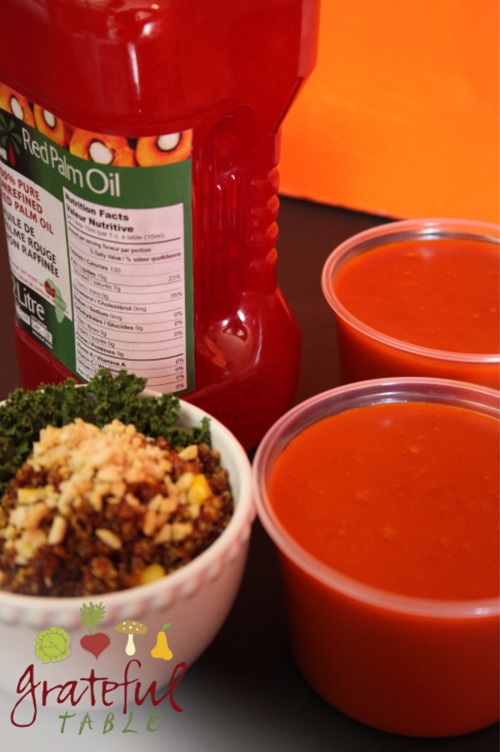
Coconut oil’s going mainstream- it’s even at Trader Joe’s. And red palm oil hit the headlines, thanks toGrateful-Table-Red-Palm-Oil Dr. Oz. But what’s the truth about red palm oil (the unrefined, bright red version, not the refined stuff that makes junk food junky).

It’s been used for over 5,000 years. So, unlike some newly created, genetically modified oils (canola, for one), it has a proven track record. (Some foods are so new that we don’t even know their effect on future generations.)

Red palm oil is loaded with carotene; it’s in a good form too, as carotene needs fat in order to be assimilated. It also contains lots of other nutrients (and I mean, lots), including super potent forms of Vitamin E. Red palm oil contains all four of the different tocotrienols, which have 60 times the antioxidant activity of our typical “vitamin E”. The tocotrienols increase blood flow to the brain and slow damage done by free radicals (aiding in Alzheimer’s and dementia prevention, too). Yay!

Another feature: even though red palm oil is a saturated fat (solid at room temperature), it has been proven anti-inflammatory, removing plaque build-up in arteries. Without a plaque build-up, less cholesterol collects in the area. The presence of cholesterol is not actually the cause of heart disease, but a symptom of a problem. And while it’s quite profitable to sell cholesterol-reducing drugs to address that symptom, how much better would it be to address the real problem?! An anti-inflammatory diet could probably do much to address heart-disease problems, and red palm oil is there to help!

Also, RPO goes straight to the liver- instant energy that doesn’t need to be processed more before getting used as energy. Easily metabolized foods are like paying cash, giving you instant energy. Alas, foods that like to turn to fat are like credit card debt: Easy to take on, but paid back with interest (or, lots of exercise and hard work). You pay a “fee” for having eaten it; since it got stored as fat instead of getting used as instant energy, you have to “pay” to get it back out of storage, before you can use it for energy!

If you’re ready for this serious super-food, find a good, sustainable oil, like this Red Palm Oil (100% Organic). From an environmentally sound source, it’s grown by small groups of farmers in West African villages. Unlike the refined stuff we become accustomed to (that is so easy to eat to excess), virgin RPO has a curious, rather strong flavor. To make it more palatable, I always use other strong flavors with it, like garlic and spices. Which are super good for us too, so that’s just fine!

 

Soul Food Sunday: The Peace of God (Philippians 4:7)

I must confess, I can’t do it all. I could post more often, but then who would do the gardening, cooking, and cleaning?!

"And the peace of God, which transcends all understanding, will guard your hearts and your minds in Christ Jesus." Philippians 4:7

But it is time to post again. It’s almost Easter Sunday, and even though I don’t have an Easter Wallpaper to post, I still thought I’d share the one I’ve got on my desktop right now. It’s good to remember this passage, from Philippians.

Just before the verse about God’s peace, verse 4:6 tells us, “Do not be anxious about anything, but in every situation, by prayer and petition, with thanksgiving, present your requests to God.” Perfect. Pray, give thanks, and don’t worry!

And verse 4:8 follows, with, “Finally, brothers and sisters, whatever is true, whatever is noble, whatever is right, whatever is pure, whatever is lovely, whatever is admirable–if anything is excellent or praiseworthy–think about such things.”

Looks like this is the recipe for Peace:

1.) Don’t be anxious

2.) Do pray and give thanks

3.) Do think about all that is good

Wallpaper: Desktop Backgrounds w/Verses

“And the peace of God, which transcends all understanding, will keep your hearts and your minds in Christ Jesus.” Philippians 4:7

If you like the verse, you might want to select one of the links below, and use the photograph and scripture for your computer background.

To use for desktop wallpaper, left click on appropriate monitor size, then right click and choose “select :

Background for wider monitors

Background for shorter monitors

Broccoli Salad: Easy Recipe for Potlucks, Parties

Here’s a version of the classic broccoli salad; a great dish for picnics and potlucks. Broccoli is one of those cruciferous, healthy veggies, so a tasty recipe that helps people eat it up is perfect. Serves 10.

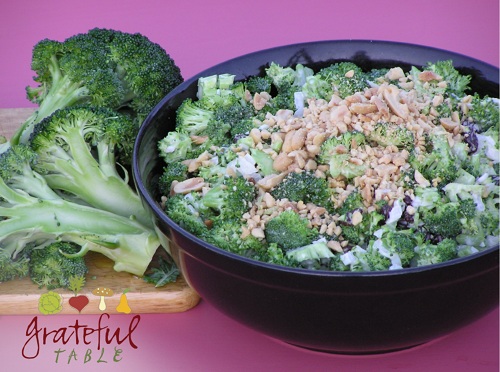
Broccoli Salad topped w/ peanuts, in black bowlINGREDIENTS

  • 1/2 c. mayonnaise
  • 1 TBS. sugar
  • 1 TBS. white vinegar
  • 6 c. fine-chopped broccoli
  • 2/3 c. raisins, golden
  • 1/2 c. red onion, diced fine
  • 2/3 c. roasted, salted peanuts, chopped (or substitute crumbled bacon or roasted, salted cashews)

PREPARATION

1. Mix the following in a big bowl: > 1/2 c. mayonnaise > 1 TBS. sugar > 1 TBS. white vinegar

2. To dressing, add: > 6-8 c. fine-chopped broccoli > 2/3 c. raisins, golden > 1/2 c. red onion, diced fine

3. Mix well. Before serving, top with: > 2/3 c. roasted, salted peanuts, chopped (or substitute crumbled bacon or roasted, salted cashews)

4. Prepare the dressing and broccoli a day ahead if desired; toss it all together at the last minute for extra freshness.

Make “Mixes” from Scratch- Healthy Way to Save Time & Money

We make “mixes” all the time at The New Deli. So, when we need to make a new batch of whatever (meatballs, meatloaf, salad dressings, etc) in a hurry, we don’t have to add a bunch of individual spices– that would take too long! We have jars of various dry mixes, and just need to add a few other ingredients to complete a recipe fast.

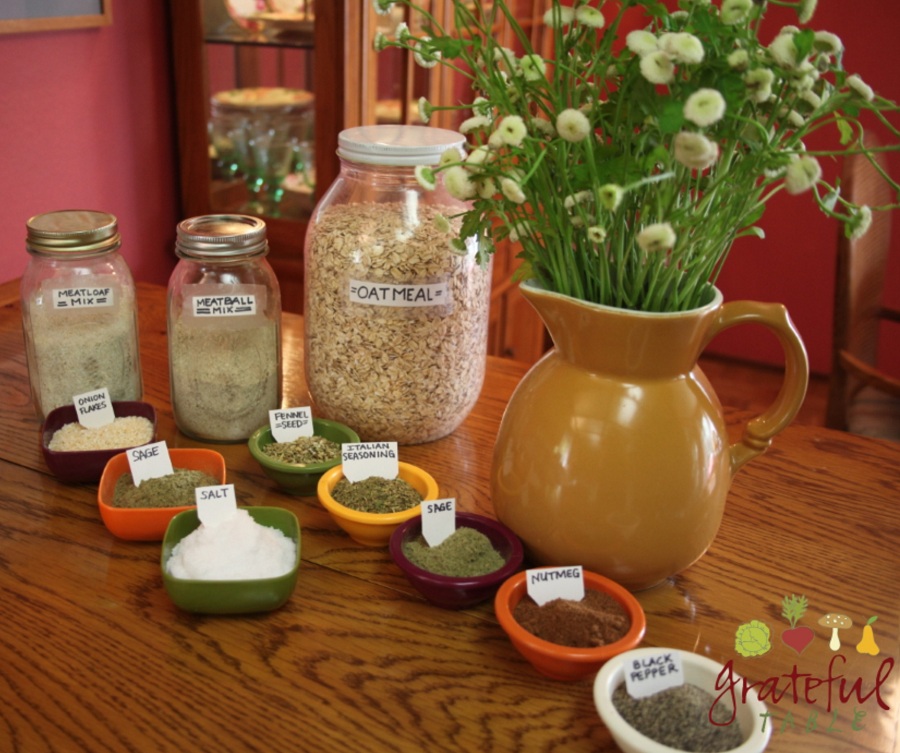
Display of sage, fennel, oats, and others herbs and spices, mixes in jars$AVE Time & Money: Four Homemade Mixes

For anything you make often enough, you will save time if you make a big batch of parts of the recipe that will store well. Examples? Angel Sweeza of Heart-Hands-Home has many recipes listed here. (She’s posted a lot of baking mixes, for bisquits, cookies, cakes, oatmeal mixes, tortillas, etc.)

Here’s four more ideas for you:

1.) “Meatball Mix”: You can check out our Spaghetti and Meatball recipe here. And you might notice that there’s a rather long list of ingredients (twelve, just in the meatballs). But we make meatballs so fast at The New Deli because we already have seven of those ingredients blended and processed into a “Meatball Mix”. All we add to that is a little Parmesan, egg, and the beef. If we want to make a vegetarian version, we just use some Parmesan, “Meatball Mix”, and a falafel-type dry mix. After adding water to that, we’ve got a vegetarian-style “meatball” that’s seasoned like yummy Italian sausage. So good!

2.) “Meatloaf Mix”: If you like to make meatloaf, and like to doctor yours up with a long list of herbs and spices, it could save time for you to have the blend on hand. You could make meatloaf several times, but more easily. At our deli, we process oatmeal with some sage, dried onion, and salt. We add some of that mix to each batch of meatloaf. Two great things are happening: We’re using a more gluten-free “filler” in place of the typical bread crumbs often added to meatloaf, and: We’re adding a few extra seasonings at the same time, without having to go through a longer list of ingredients, adding them one at a time, each time.

Another nice thing about having this blend of oats and herbs around: Wow, it makes a great dredging “flour” for chicken. (A gluten-free flour at that!)

If you happen to love The New Deli’s meatloaf, and want to make it yourself, we do add another long list of goodies to it. But we don’t add ’em one at a time- we have a seasoned tomato paste on hand; we just add a spoonful of that to each batch of meatloaf. If you want that recipe, you can find it here. (It also has multiple uses, for salad dressing, soups, etc.)

3.) Italian Dressing Blend: Another trick of the trade, from The New Deli! We get pretty busy most days, and don’t have time to make each batch of Italian from scratch. But we do have time to mix it up, using some of the “Italian Dressing Concentrate” that we keep in the freezer. It is a processed blend of fresh garlic, basil, oregano, tarragon and salt; when we’re running low, we blend up some of it with olive oil and red wine vinegar. The immersion blender works great for this, but a regular blender or processor, or even hand-whisking, would work too.

For the exact recipe for a single batch of the dressing, see here. But you can increase the recipe and store portions in the freezer, like we do. It’s quite handy!

4.) Taco Mix: If you make lots of tacos, you might try making your own taco mix. For starters, you can make your own chili powder. The main ingredients are cumin powder, paprika, garlic powder, and cayenne (and perhaps some ground oregano). Many companies also add MSG, but who needs that?!

Experiment to get your favorite blend, for “Taco Seasoning”.  It did seem that, to be “authentic” (as in “more like store bought”…), my mix needed a hearty dash of sugar. Palm sugar would be a healthy substitute, and it would still give that taco meat that flavor we love. All I added to the mix was some homemade chili powder, sugar, and salt. A dash of vinegar tossed in after cooking the beef was the finishing touch. The kids were pretty impressed with a homemade taco mix that tasted (at least) as good as store bought. Only cheaper and healthier!

PS I’ve added this post to the “Simple Lives Thursday” blog hop post on my online friend Diana’s website, My Humble Kitchen. Lots more good links to articles for making life more simple!

How Not to Kill a Mocking Bird (Urban Homesteading Gone Bad)

Grateful-Table-Jungle-YardFREAKY FRIDAY: Pet Stories of a Wannabe Frontier Woman

It’s Friday already. Guess it’s time for a fun post (not so food-related, but that’s OK, right?)

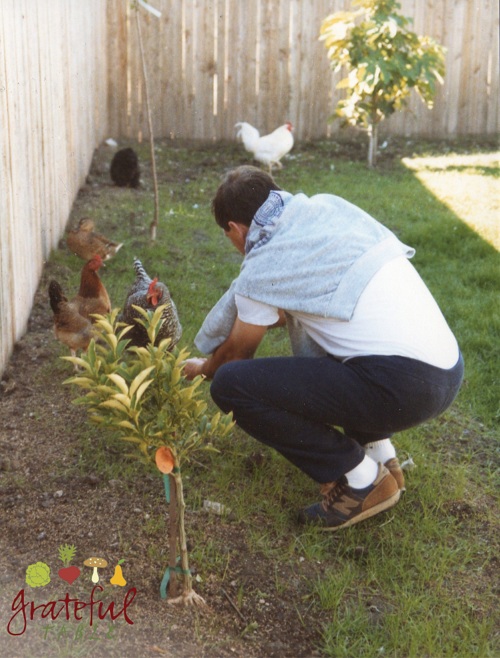
You can make out a corner of our “jungle” in this first picture. Twenty-eight years later, full of mature trees. That same corner of the yard didn’t look that lush when we first moved in! That was back when we thought having chickens would be a good thing… (You can see a picture from 1986 on the left, featuring my dad feeding the chickens. The trees were pretty small!)Grateful-Table-Early-Yard-Baby-Trees

We also had a puppy. Briefly. A friend had convinced us to adopt a Doberman Pincher puppy that needed a home. Big mistake! Miles was 3 years old, the “puppy” would barrel him over, not to mention, chew everything in sight.Grateful-Table-Young-Son-w-Dog-Baby-Avo-Tree Both she (“Lenka”) and Miles look so relaxed, sitting next to the avocado tree we’d just planted. (Which is now two-stories tall!) She looked pretty harmless in the pic on the right, but don’t be fooled.

Lenka saw to it that the drip system we’d put in got chewed up; the seat belt left hanging outside the car door got destroyed… even the plastic-encased metal rope we used to tether her to a long line in the doggy run area got chewed up. It was crazy. Didn’t last. Put an ad in the paper and found her a new home… Even though she was awfully cute. As a puppy.

Grateful-Table-Two-Sons-One-ChickenMeanwhile, we procured some cute baby chicks and ducks. They ate pretty much every new plant I put in. They had their good points while it lasted: Great eggs and good fertilizer. They ate all the deli veggie scraps that we brought home. Great compost!

Alas, that too was not meant to last. I had tried to keep the rooster from bothering our little toddler, but it had jumped up and pecked on baby Tyler’s head one too many times. It was almost mocking us! Grrr– Mama bear was angry! Mind you, I was not really a frontier woman. I didn’t have a sharp ax to chop off the chicken’s head. (They say that’s a messy way to do it anyway.)

But I did wring its neck. This was in 1989, before I even knew about the internet, or I could have looked up this article on how to properly kill a chicken. I would have then known that “wringing its neck” (despite the expression), is not the best way to accomplish the task. Peter Dickerson’s humane directions (whereby the head is quickly detached in a particular grip, while holding the bird upside-down) would have been better to follow…

I do not recommend chicken slaughtering for the majority of us. As disturbing as killing it is, it will also continue to move around a bit (even when killed humanely). They say it’s “just the nerves”, but it’s very unnerving! I held my poor old rooster down, that last minute or two while he twitched, and I cried.

A freshly killed chicken also needs to be “dressed”. You can watch a video here, on how to do that. I didn’t have the video–I was on my own, pulling weird stuff out of that bird, and, well… it got pretty gross!

I didn’t want to eat chicken for quite some time. I did try to turn that old rooster into good stock for soup. The meat tasted like rubber bands, and I couldn’t quite stomach the chicken stock after the traumatic experience. I haven’t killed my own livestock since, But if I ever try again, I’m going to follow directions!

Now we just have a cat. And a few fish in our pond. That’s about our speed right now. And there’s enough stray cats around, siting on fence posts looking pretty, that we never get too lonely for a new pet…

Life is good : )

Quinoa Spring Rolls w/Rice Wrapper: Hi Protein, Gluten-Free!

A refreshing appetizer or party food, this even healthier version of a Vietnamese favorite uses quinoa to add whole grain goodness. So it’s gluten-free, and can be served to vegans, too.

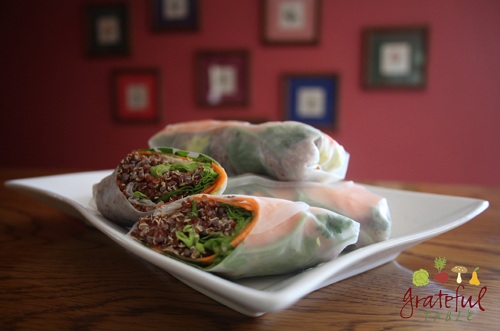
Quinoa, carrot, and herbs in rice wrappers, on plate

Traditional Vietnamese spring roll wrappers (made from rice flour) might only be found at international markets, or online at Amazon, but can be a worthwhile investment, especially for those with gluten intolerance.

Makes 24.

SPRING ROLL INGREDIENTS

  • 3/4 pkg. spring roll wrappers (about 24)
  • 1 c. quinoa, red or other *
  • 2 c. boiling water (less if quinoa is pre-soaked)
  • 1/4 c. toasted sesame oil
  • 1 TBS. fresh grated ginger (or 1 tsp. dry)
  • 1 TBS. chopped garlic
  • 2 TBS. soy sauce
  • 1/2 TBS. rice vinegar (or substitute white vinegar)
  • 1 c. roasted peanuts, chopped (optional)
  • 2-3 carrots
  • Butter lettuce, Napa cabbage, or other favorite (bean sprouts, shrimp, etc.)
  • 1/2 bunch of favorite herbs (any or all of the following: cilantro, fresh mint, basil)

SPICY PEANUT SAUCE INGREDIENTS*

*For Variations, see “Alternative Peanut Sauce”, bottom of page

  • 1/4 c. honey
  • 1/4 c. white vinegar
  • 1/4 c. sesame or peanut oil
  • 1/4 c. peanut butter
  • 1-2 cloves garlic, minced
  • 1/2 tsp. pepper flakes (or hot pepper oil or Tabasco, to taste)
  • Optional: 1/4 c. chives, chopped (or green onion)
  • Optional: 1/4 c. red pepper, finely chopped

PREPARATION

1. Prep quinoa a day ahead if possible, as it’s best for it to soak, to remove the bitter (and slightly toxic) saponins. As easy method is to soak it overnight (or for several hours) in a bowl with plenty of water. It will triple in size, so use a big enough container. Strain and rinse the quinoa. If soaked, cook it using less water, and for a shorter length of time.

2. Earlier in the day, cook quinoa. To a 2 qt. pot, add: > 1 c. soaked red quinoa (or other) > 1 c. boiling water

3. If the quinoa hasn’t been soaked, rinse it under cold water for a minute or two, then cook it in a 2-quart pot, adding: > 1 c. rinsed red quinoa (or other) > 2 c. boiling water

4. Cook the quinoa about 15 minutes (longer if not pre-soaked), until light and fluffy. Set aside to cool.

5. Prep veggies to use in assembling spring rolls. Peel carrots, “shaving” large, thin strips off with a potato peeler. Use: > 2-3 carrots

6. Rinse and drain cilantro and other herbs: > 2 c. or so total of favorite herbs (cilantro, mint, and/or basil)

7. Slice lettuce into strips: > 1 head Butter lettuce (or Napa cabbage, or other favorite)

8. Season quinoa by mixing into it, the following ingredients: > 1/4 c. toasted sesame oil > 1 TBS. fresh grated ginger (or 1 tsp. dry) > 1 TBS. chopped garlic > 2 TBS. soy sauce > 1/2 TBS. rice vinegar (or substitute white vinegar)

9. To assemble the spring rolls, soak each wrapper in warm water for about 30 seconds, until pliable. In the lower center of each wrapper, add the following: > a few pieces of herbs > a few strips of the thinly sliced carrot > a few strips of lettuce (or cabbage) > a sprinkling of chopped peanuts > about 1/3 c. quinoa mixture

10. Wrap up as if wrapping a burrito. Repeat, to make 24 or so rolls. Cut the spring rolls in half diagonally, if desired. Serve with Peanut Sauce (or even without!).

Spicy Peanut Sauce

1. Warm the following to steep the garlic some. Microwave 1-2 minutes in a small bowl, or heat in small pan: > 1/4 c. honey > 1/4 c. white vinegar > 1/4 c. peanut or sesame oil > 1-2 garlic cloves, minced

2. Whisk in until smooth: > 1/4 c. peanut butter > 1/2 tsp. red pepper flakes (or hot pepper oil or Tabasco, to taste)

3. If desired, stir in the following, to add color: > 1/4 c. chives, chopped (or green onion) > 1/4 c. red pepper, finely chopped

ALTERNATIVE PEANUT SAUCE INGREDIENTS

  • 1/4 c. sugar
  • 1/4 c. white vinegar
  • 1/2 c. coconut cream
  • 1/4 c. peanut butter
  • 1/4 tsp. turmeric (for health- it doesn’t add much flavor)
  • 1/4 tsp. cayenne
  • 1/2 tsp. curry (or other spices- ginger, cumin powder, etc.)
  • 1/4 tsp. salt

Alternative Peanut Sauce- Preparation

1. Heat in small pan until sugar’s dissolved: > 1/4 c. sugar > 1/4 c. white vinegar

2. Add to the sugar syrup in pan, stirring in until smooth: > 1/4 c. coconut cream > 1/4 tsp. turmeric > 1/4 tsp. cayenne > 1/2 tsp. curry > 1/4 tsp. salt

3. Last, blend in: > 1/4 c. peanut butter

4. Ready to serve- makes a thicker sauce, which is easier to dip into, without drips!

* For reference, 1 c. quinoa will multiply in size, yielding 5 c. or so after cooking

4 Things About Life & Gardening & Enemy #1: Yellow Sorrel

FREAKY FRIDAY: A Break from the Usual, A Taste of the Wild and Wooly

I loved the movie “Freaky Friday”. And I needed a name for posts that didn’t fit under my more typical categories (“Easy Recipes”, “Healthy Eating”, etc.). I decided I could post them on Fridays, under the heading, “Freaky Friday”. Whoo hoo!

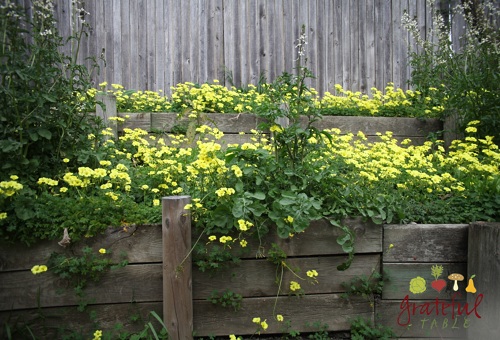
Too much oxalis in raised beds

Today’s story is about gardening. I’ve been having a problem with yellow sorrel. (Also known as sour grass, of the oxalis family.) It’s a pernicious weed with tiny bulblets; even when you pull up the plant, the bulblets usually remain. And they quickly repopulate your garden. Grrr.

I researched for several years, hoping for an easy solution. (I thought a simple soil supplement that amended the acid/alkaline ratio might help, or perhaps some other organic solution.) Alas, no easy fix. I finally implemented the best solution I could find, which was to cover the weeded surface with cardboard, then top with bark (you can also top with fresh soil).

At least we have an endless supply of New Deli cardboard, and it’s biodegradable, so it will serve as a mulch, but eventually break down. All the while, serving to keep those sorrel plants from repopulating. And I’m encouraged, as the yard is now covered with a few hearty perrenials, topped with wood chips. No sorrel!

I was even able to call my tree guy and get free wood chips- a whole truckload got dumped out front. Awesome!

Grateful-Table-Garden-View-of-Forget-Me-NotsBut I took a look at an older garden picture from a few years back. The Pre-Sorrel Period. Wow- it was beautiful! An abundance of other aggressive ground covers had taken over: Forget-me-nots, and some other daisy-type ground cover.

I might not have fully appreciated that yard at that point. I might have taken those aggressive (but beautiful) volunteer Forget-me-nots for granted. But now that I’ve wrestled with yellow sorrel, I have a new appreciation for this yard!

I’m hoping to learn a few things here:

1.) Treat yellow sorrel as a serious enemy, to be defeated at first sight.

2.) Be really grateful when your garden (or life) is not inundated with weeds (or other pains).

3.) Take nothing for granted. Not even a simple volunteer “weed” like Forget-me-nots.

4.) Sometimes a simple thing (like Forget-me-nots), that is eagerly taking up space, is keeping out something evil (like sorrel).

Oils- Which Are Healthy? (+ 5 Great Things About Olive Oil)

A friend wondered: Is grape seed oil good? Answer- yes and no, but mostly no. (See Caroline Barringer ‘s article here). It’s been claimed that it can increase HDL-C (good cholesterol), and decrease LDLs (bad stuff), and it has a higher smoke point than many oils, for cooking (grilling stuff in a pan, etc.). But it is not as stable as olive oil; it’s more prone to oxidation, which isn’t good. Polyunsaturates (such as grapeseed oil) tend to oxidize when heated, even at low temperatures. They might not smoke as quickly under heat, but that doesn’t mean they’re actually good for you.

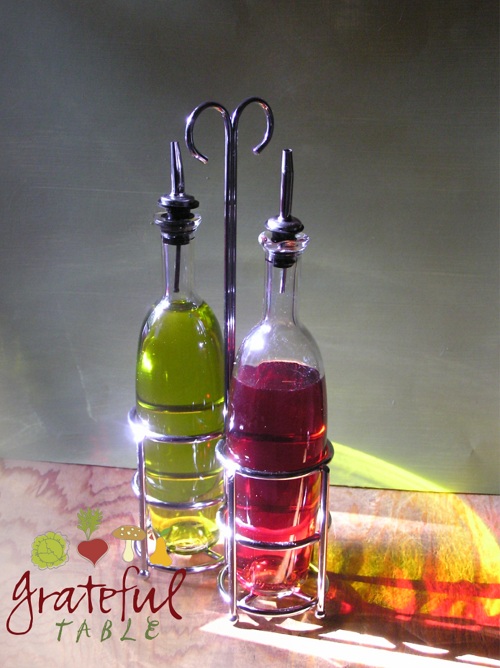
Virgin Olive Oil and Red Wine Vinegar Bottles

Grape Seed Oil comes from actual grape seeds after wine production, and might get confused with “rapeseed oil”, now also known as Canola Oil. But rapeseed oil is an entirely different animal, of the mustard/cabbage family. It was a somewhat toxic oil, but got genetically modified to make it more “fit” for human consumption. Without modification, it was high in erucic acid (which can damage heart muscle), and glucosinolates (which blocked absorption of nutrients in a study of its effect on animals). Not good! So scientific engineers went to work, creating a product they called “Canola Oil”, as it was developed in Canada. Bottom line: Canola Oil is GMO. Ew! I’ll be trying to avoid it whenever possible…

There are also the standard “PUFA”s (polyunsaturated fatty acids), represented in safflower oil, corn oil, and the like. Although food company marketing has touted such oils as “heart healthy”, you might read this article on Mark’s Daily Apple, for a completely different perspective. He takes about balancing the Omega 6 to Omega 3 ratio in our bodies, through eating the right foods. I changed my diet after reading that info, and noticed a dramatic change in the inflammatory-based symptoms I had. Those symptoms are gone!

Other oils are making the news these days, and I’ve been doing a lot of research. Thanks to Dr. Oz (who featured shows about them), coconut oil and red palm oil have become popular. But I’ll address those oils at a later date. For now, let’s focus on olive oil, a more common oil.

THE BEAUTY OF OLIVE OIL

1.) Proven Track Record: Olive oil has been used forever- it’s mentioned countless times in the Bible (well, I personally couldn’t count ’em…) Anything that’s been around that long speaks for itself. Newly created products might eventually show their (as yet, unforeseen) long-term health affects upon future generations, but with olive oil, we can rest assured.

2.) Fresh, not Rancid: A really cool thing about olive oil: it doesn’t require excessive heat to extract the oil from it. (Unlike other sources, like safflowers, corn, etc.). So the quality of the oil doesn’t deteriorate or get rancid from its exposure to heat during processing, as readily as other oils.

3.) Anti-inflammatory: Another plus is that olive oil is rich in polyphenols (antioxidants that have anti-inflammatory and anticlotting properties). Newly pressed extra-virgin olive oil contains oleocanthal, a compound that can act in a similar way to ibuprofen. Researchers say that a diet rich in olive oil may have pain-relieving and heart-health benefits similar to those of taking a low-dose baby aspirin every day.

4.) It’s Part of the Mediterranean Diet: Following the traditional dietary patterns of southern Italy, Greece, and Spain, has been shown to lower heart disease risk, lengthen lifespan, reduce cancer and diabetes, and help with weight loss. Sign me up!

5.) Reasonable smoke point: This means that olive oil has a smoke point of about 385-420 degrees. Granted, you don’t want to get a pan so hot that the oil you add starts smoking; that can create undesirable by-products. But to use olive oil to cook foods at mid-range heat presents no problems.

HOW TO BUY IT

Cold-Pressed (Like this one, from Bariani): Cold-pressed means no heat was used during the processing. If that’s too pricey, opt for a more inexpensive extra-virgin olive oil for cooking, then splurge on a high-quality, unfiltered one for drizzling and dipping (when you’ll most appreciate its amazing flavor).


Dark Bottles: Dark-colored bottles will keep better, as light and heat can turn oil rancid. A dark cupboard works well for storing it in, or store it in an opague ceramic decanter. It can be refrigerated, but it will firm up (remedied by leaving it out for a half hour or so). Olive oil is best used within six months but can last longer if stored properly.

Organic: We can’t always afford it, but the world would probably be a better place if we spent more money supporting sustainable practices, and spent less money on excessive quantities of inferior products. We’d probably solve the obesity epidemic too!

Soul Food Sunday: Matthew 4:4 (Word: The Real Bread of Life)

Wallpaper: Desktop Backgrounds w/Verses

Bread, butter, and water: "Man does not live on bread alone, but on every word that comes from the mouth of God." Matthew 4:4Have you ever eaten something you thought you were craving, but it didn’t seem very satisfying? I’ve noticed that food is not always the thing I’m craving! Matthew 4:4 says:

“Man does not live on bread alone, but on every word that comes from the mouth of God.”

I made this Bible verse into a Christian background for my computer- it’s a great way to remember a Bible verse. If you’d like to put the wallpaper on your computer, just follow these directions:

To use for desktop wallpaper, left click on appropriate monitor size, then right click and select “Set as Desktop Background”. Enjoy!

Background for wider monitors

Background for shorter monitors